
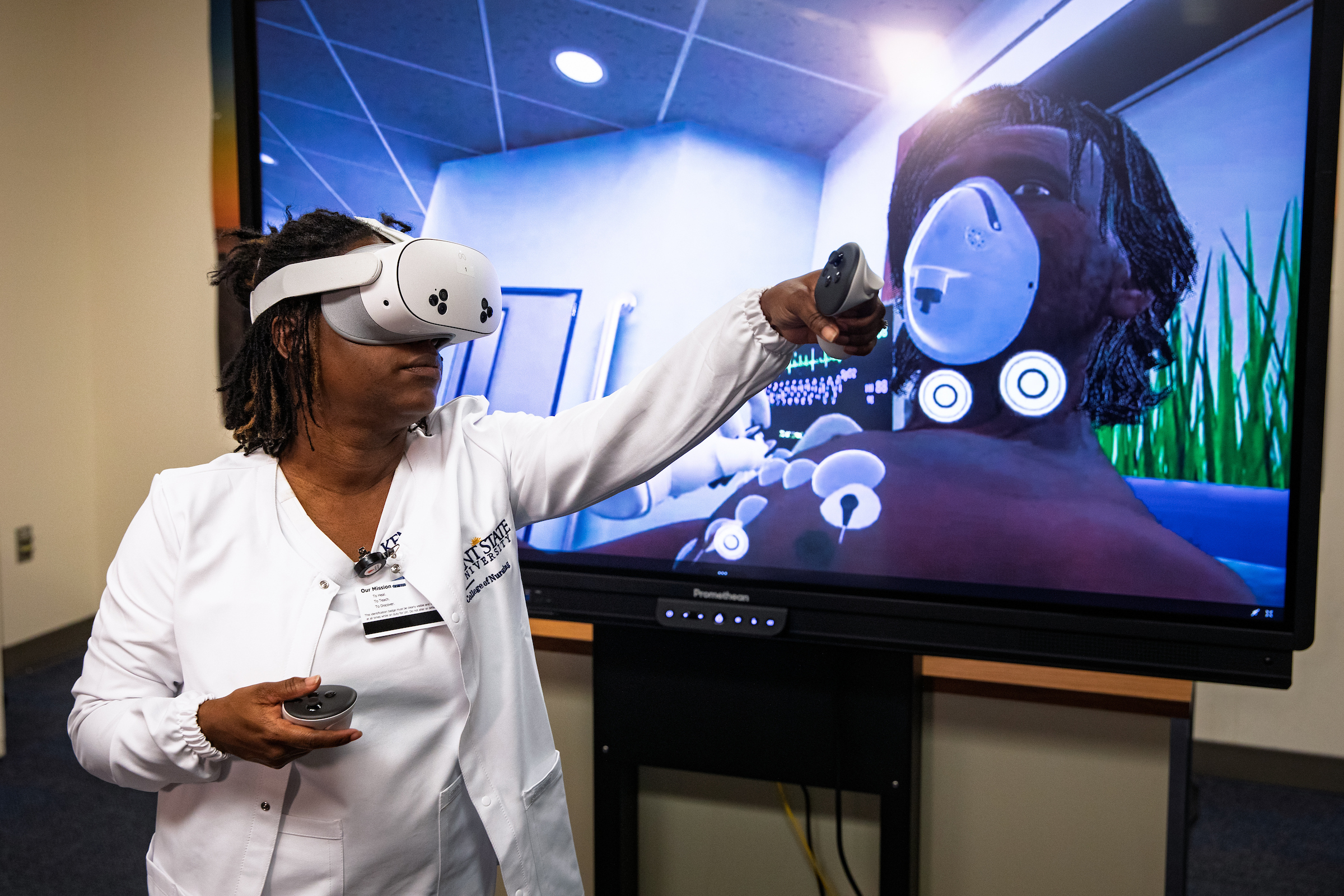
丁香五月婷婷中文's College of Nursing is equipping tomorrow's healthcare workforce with cutting-edge technology that bridges classroom learning and bedside care. The College has introduced AI-powered virtual reality simulation鈥攁 first-of-its-kind application in nursing education that standardizes clinical practice while giving each student individualized feedback on their performance.
The technology transforms how students learn critical nursing skills. Rather than the traditional simulation model where one student performs while peers observe, VR headsets create an immersive, personalized learning environment. Students interact with a virtual patient who responds in real time, complete with vital signs, electronic health records, and even a virtual physician they can consult. If they miss critical details or fail to maintain eye contact during patient communication, the system responds authentically鈥攋ust as a real patient would.
"This is the first time students are really getting to perform simulation in a virtual setting," said Janet Reed, Ph.D., RN, CMSRN, an assistant professor in the College of Nursing. "It standardizes the experience and allows them to get individual patient feedback. Normally with simulation, they don't get feedback except from their instructor, and often it's one person doing most of the tasks while everyone else stands around observing."
The AI advantage extends beyond the simulation itself. Natural language processing analyzes everything students say and do during the exercise, generating personalized insights on their clinical decision-making, communication skills, and technical proficiency. Students can review videos of their performance and written documentation feedback, identify gaps in their practice, and repeat scenarios until they achieve mastery. This safety to fail, learn, and try again builds both competence and confidence. These virtual simulation tools were purchased using HRSA Nurse Education, Practice, Quality and Retention (NEPQR)鈥揚athway to Registered Nurse Program (PRNP) grant funding through the LPN Education Advancement Program (LEAP), which helps students develop professional communication, clinical judgement and safe nursing practice as an RN
For Ebony Beckwith, an LPN working in neurology while pursuing her degree through the LEAP program, the simulation feels authentically clinical. "It feels 100% real," she said. "The virtual patient talks to you and responds in real time. You're making mistakes here and learning from them鈥攂ut those mistakes don't matter in a way they would on the floor."
The program's impact extends to working nurses seeking to refresh skills. Krystle Woods, a pain management nurse in her third year of the four-year program, sees the technology as essential for clinical competency in an evolving healthcare landscape. "As a nurse, I work in a doctor's office, so doing hands-on bedside simulation is helping me refresh my skills," she said. "It teaches you how to be there at the bedside鈥攕ome people don't have that experience, so this is a better way to learn before stepping in and potentially freezing up."

The versatility of VR simulation allows the College to create high-acuity scenarios鈥攕epsis, anaphylaxis, medication errors鈥攖hat students may never encounter in traditional clinical rotations. Students can practice critical judgment in a controlled environment before facing these situations with real patients. This aligns squarely with the College of Nursing's mission to produce compassionate nurses who advance health while demonstrating lifelong learning and innovative practice.
The data collected from each simulation creates measurable learning outcomes. Every student's transcript, verbal interactions, and performance metrics are recorded, providing the College with robust analytics on what students learned, how they improved, and where additional support may be needed. This evidence-based approach to nursing education strengthens program quality and ensures graduates are ready for licensure exams and clinical practice.
"We get so much data, and now we can use AI to help analyze it," Reed explained. "Every student who completes a VR simulation gets a full transcript and analytics that track their performance and provide generative AI feedback on how they communicated therapeutically with the patient, what they did well, and what they could do better."

While VR simulation is not meant to replace clinical experience鈥攊t complements and prepares students for it鈥攖he technology positions 丁香五月婷婷中文's nursing programs as leaders in innovative health professions education. As healthcare systems increasingly demand nurses who can think critically, communicate effectively, and adapt to complex clinical environments, 丁香五月婷婷中文 is ensuring its graduates arrive with both theoretical knowledge and practical confidence.
The College's investment in this technology reflects a broader commitment to transforming lives through compassionate, competent nursing education. In training the nursing workforce of tomorrow, 丁香五月婷婷中文 is building not just individual clinical skills, but a culture of continuous learning, innovation, and excellence that will ripple across the health systems where its graduates practice.
About 丁香五月婷婷中文's College of Nursing
The College of Nursing is dedicated to transforming lives by producing compassionate nurses who advance health locally, nationally, and globally. The College offers multiple pathways to nursing careers, including the Bachelor of Science in Nursing (BSN), Master of Science in Nursing (MSN), Doctor of Nursing Practice (DNP), and Ph.D. in Nursing Science. Through innovative education models built on integrity and critical thinking, the College prepares nurses and nurse leaders for diverse roles in healthcare, research, and advanced practice.